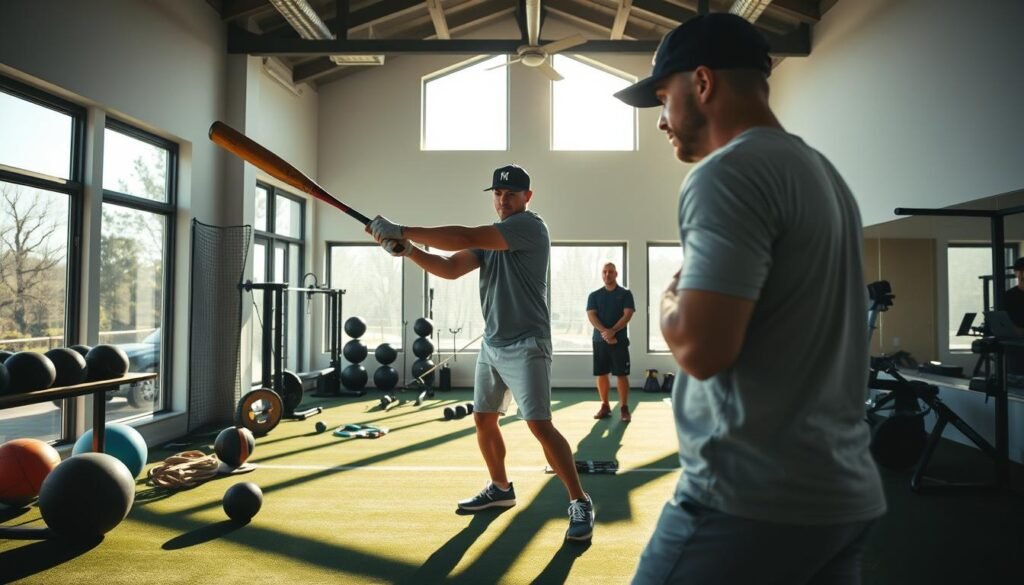
Did you know that a dedicated baseball player can improve their game by up to 30% through consistent training and workouts?
Becoming a great baseball player requires more than just playing the game; it demands a well-structured workout regimen that enhances your body‘s agility, strength, and overall performance. Embracing specialized baseball workouts is crucial for standing out on the diamond.
Our comprehensive guide provides baseball workouts at home that require minimal equipment, making it accessible for players of all levels to achieve maximum results. By following the Fit Glow Guide philosophy of “Your Body. Your Glow. Your Guide,” we emphasize personalized training approaches to help you achieve peak performance.
Key Takeaways
- Effective at-home training methods for baseball players
- Minimal equipment required for workouts
- Personalized approaches to enhance performance
- Essential warm-up routines and strength-building exercises
- Transforming household items into baseball workouts tools
Why Baseball-Specific Training Matters
Tailored training programs are essential for baseball athletes aiming to improve their game. The first and foremost role of targeted baseball workouts is to increase the strength and agility of players.
Performance Benefits for Baseball Players
Baseball-specific training targets the exact muscles and movement patterns used during gameplay, creating a direct transfer of strength and power to your performance on the field. This type of training enhances the explosive power needed for actions like throwing and batting, ultimately driving in-game results.
Injury Prevention Advantages
Beyond enhancing performance, baseball-specific workouts help players prevent injuries on the field. Specialized training strengthens vulnerable areas like the rotator cuff and improves shoulder stability.
Following the Fit Glow Guide approach, baseball-specific training acknowledges that each athlete has unique needs and goals. This personalized development addresses the fundamental physical requirements of the sport.
| Benefits | Description |
|---|---|
| Enhanced Strength | Increased power for throwing and batting |
| Injury Prevention | Strengthening vulnerable areas like the rotator cuff |
| Improved Performance | Measurable improvements in bat speed and throwing velocity |
Essential Equipment for Home Baseball Workouts
You don’t need a fully equipped gym to perform effective baseball workouts; simple household items can suffice. The key is to be creative with the resources you have available.
No-Equipment Options
Bodyweight exercises are a fundamental part of any workout routine, including baseball training. They help improve strength, flexibility, and endurance. Effective bodyweight exercises include squats, lunges, push-ups, and planks, which target various muscle groups essential for baseball players.
- Squats and lunges for leg strength
- Push-ups for upper body strength
- Planks for core stability
DIY Alternatives
For those who need a bit more resistance, household items can serve as excellent substitutes for traditional weights. Water bottles, canned goods, and even gallon jugs of water can be used to add resistance to your workouts. For example, you can perform bicep curls with filled water bottles or use a gallon jug for shoulder presses.
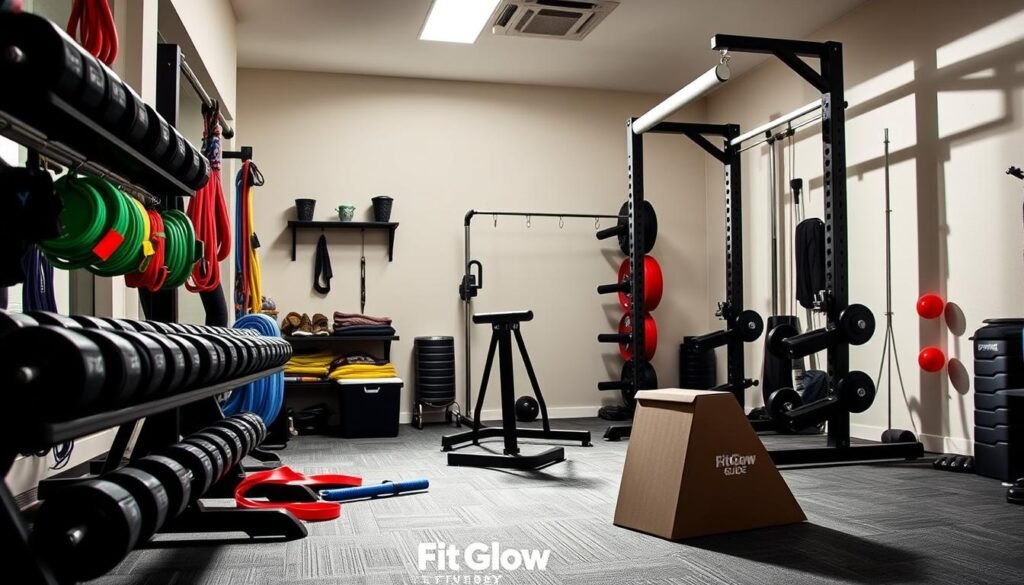
Additionally, creating DIY resistance bands from household items or inexpensive exercise bands can provide an effective way to strengthen your throwing arm and prevent common baseball injuries. A single medicine ball can also dramatically expand your home baseball workout options, particularly for developing rotational power.
- Use water bottles or cans as dumbbells
- Create resistance bands from household items
- Incorporate a medicine ball for rotational strength
By leveraging these no-equipment options and DIY alternatives, you can create a comprehensive baseball workout program at home that is both effective and affordable.
Proper Warm-Up Routine
The foundation of a successful baseball workout lies in a proper warm-up routine. A well-designed warm-up prepares the body for the physical demands of the game, reducing the risk of injury and enhancing overall performance.
Dynamic Stretching Exercises
Dynamic stretching exercises are crucial for baseball players as they activate the muscles used in baseball movements, increasing blood flow and range of motion. This type of stretching is particularly beneficial before activity as it does not decrease performance like static stretching might.
Activation Drills for Baseball Players
Activation drills are essential for preparing players for the explosive movements required during training and gameplay. These drills help improve muscle activation and coordination.
A-Skips and Arm Circles
A-Skips serve as both a warm-up and a technique-building exercise, developing the high-knee running form that translates to better base-running speed. Arm circles, performed in both forward and backward directions, prepare the arm and shoulder complex for throwing motions by increasing blood flow to the rotator cuff muscles.
Jumping Jacks and Carioca
Jumping Jacks are an excellent full-body activation exercise that raises core temperature while engaging multiple muscle groups. The Carioca or grapevine drill activates the hip muscles and improves lateral movement patterns crucial for fielding ground balls and quick directional changes.
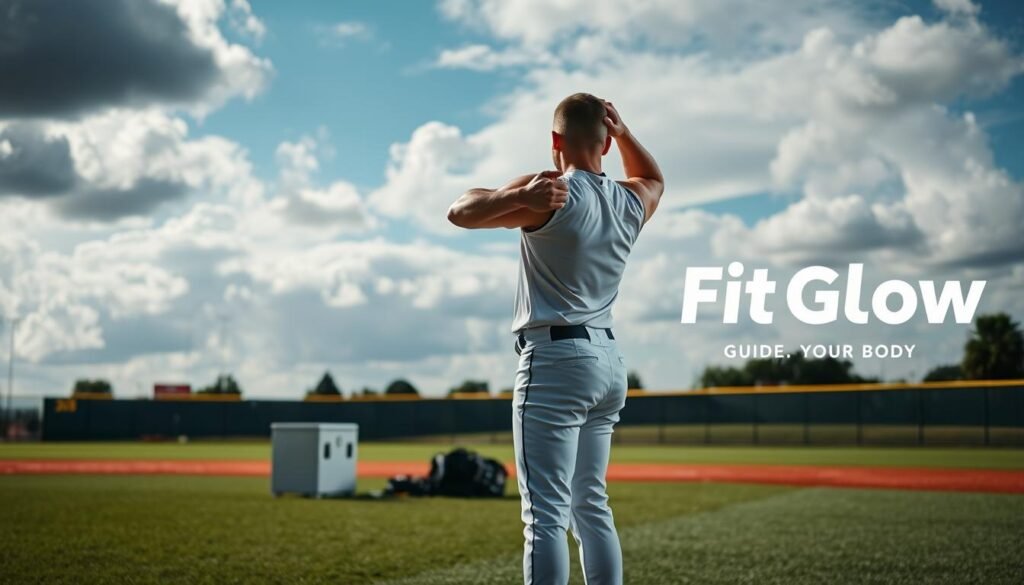
Following the Fit Glow Guide approach, a progressive warm-up routine that begins with simple movements and gradually increases in intensity is recommended to properly prepare the body for more demanding baseball-specific exercises.
Effective Baseball Workouts at Home
Effective baseball workouts at home require a combination of lower body power development and upper body strength builders. This balanced approach ensures that baseball players can improve their overall performance.
Lower Body Power Development
Lower body power is crucial for explosive movements in baseball, such as batting, throwing, and sprinting. Squats and lunges are fundamental exercises that build the necessary strength.
Squats and Lunges
To develop lower body strength, incorporate squats and lunges into your workout routine. For squats, aim for 4 sets of 10-12 reps. For lunges, do 3 sets of 10-12 reps per leg. These exercises will improve your power and stability on the field.
Upper Body Strength Builders
Upper body strength is essential for throwing velocity and batting power. Exercises like push-ups and dumbbell rows are effective for building the necessary muscles.
Push-Ups and Dumbbell Alternatives
For upper body strength, include push-ups and dumbbell exercises in your routine. If you don’t have dumbbells, you can use water bottles or backpacks filled with books as alternatives. For push-ups, aim for 4 sets of 10-12 reps. For dumbbell rows, do 4 sets of 10-12 reps per arm.
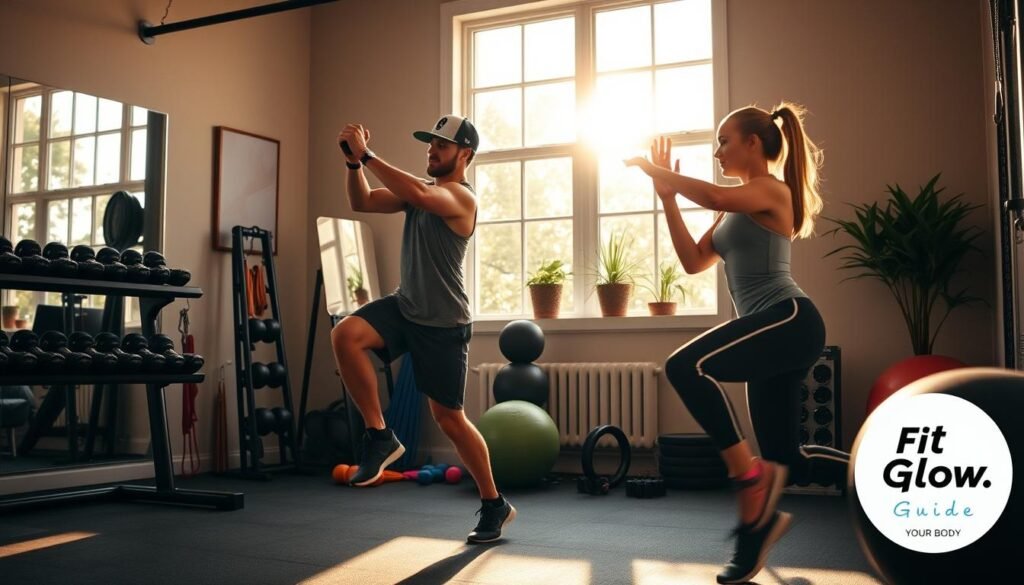
Following the Fit Glow Guide philosophy, these workouts can be adjusted based on your fitness level, ensuring progressive challenges and optimal recovery.
Core Training for Baseball Performance
The core is the central element that drives a baseball player’s strength and agility. A well-developed core enables players to perform at their best, whether they’re swinging a bat or throwing a pitch.
Rotational Core Exercises
Rotational core exercises are vital for baseball players as they mimic the twisting motions used in swings and throws. Exercises like Russian twists directly target the oblique muscles, which are crucial for generating torque and power.
Stability and Balance Drills
Stability and balance drills are equally important as they improve a player’s ability to maintain proper body positioning during complex movements. This results in more consistent fielding, throwing, and batting mechanics.
Planks and Russian Twists
Planks build isometric core strength, helping players maintain proper posture throughout games. Russian twists, on the other hand, target the obliques, enhancing rotational power. A sample core workout routine could include:
- Crunches: 20 reps
- Leg Lifts: 20 reps
- Russian Twists: 20 reps per side
The Fit Glow Guide emphasizes quality over quantity in core training, focusing on proper form and controlled movements.
| Exercise | Reps | Benefits |
|---|---|---|
| Crunches | 20 | Strengthens abdominal muscles |
| Leg Lifts | 20 | Targets lower abs and improves core stability |
| Russian Twists | 20 per side | Enhances rotational power and oblique strength |

Core training is not just about doing a few exercises; it’s about creating a comprehensive strength training program that supports all baseball movements. By incorporating rotational core exercises and stability drills, players can significantly improve their performance on the field.
Explosive Power and Agility Drills
To take your baseball training to the next level, incorporating explosive power and agility drills is crucial. These exercises are designed to enhance your ability to make quick, powerful movements on the field, directly impacting your performance in games.
Medicine Ball Workouts
Medicine ball workouts are an excellent way to develop rotational power, a critical component of baseball. Exercises like rotational throws and slams can improve your batting performance and throwing velocity. According to the Fit Glow Guide, “explosive training should be performed when the body is fresh, ideally at the beginning of workouts after a thorough warm-up, to maximize power output and reduce injury risk.”
Some effective medicine ball exercises include:
- Rotational throws
- Slams
- Overhead throws
Ladder Drill Alternatives at Home
You don’t need specialized equipment to improve your agility. Ladder drills can be replicated at home using chalk, tape, or household items. For example, you can create a ladder pattern on your driveway or floor and perform various footwork drills. This type of training enhances your agility, speed, and reaction time, making you a more effective player on the field.
| Drill Type | Benefits | Equipment Needed |
|---|---|---|
| Medicine Ball Workouts | Improves rotational power, batting performance, and throwing velocity | Medicine ball |
| Ladder Drill Alternatives | Enhances agility, speed, and reaction time | Chalk, tape, or household items |
Recovery and Cooldown Techniques
Recovery is a vital component of any baseball training program, allowing athletes to repair and strengthen their muscles. As emphasized by the Fit Glow Guide philosophy, recovery is when actual physical improvement occurs, as the body repairs and strengthens muscle tissue during rest periods between workouts.
Static Stretching Routine
A comprehensive static stretching routine should target all major muscle groups used in baseball. This includes focusing on the shoulders, rotator cuff, hips, and lower back, which experience the most stress during play. Static stretching after workouts, when muscles are warm, helps improve flexibility and range of motion.
Some essential stretches include:
- Chest/Shoulder Stretch
- Upper Back Stretch
- Hamstring Stretch
- Hip/Low Back Stretch
- Triceps Stretch
Hold each stretch for 10-20 seconds and repeat 2-3 times to maximize the benefits.
Recovery Tips Between Workouts
Baseball athletes should implement adequate rest days in their training schedule, with 48-72 hours of recovery recommended between intense workouts targeting the same muscle groups. Proper recovery techniques include:
- Proper hydration
- Nutrition strategies that support muscle repair
- Quality sleep
- Active recovery techniques like light movement on rest days
Monitoring recovery through techniques like tracking morning heart rate or using perceived exertion scales can help baseball players avoid overtraining and optimize their workout timing for maximum performance gains.
Conclusion: Building Your Baseball Training Routine
Developing a personalized baseball workout routine can help players achieve their full potential. To excel in baseball, it’s crucial to balance different types of workouts, including strength training, explosive power development, and agility work, along with adequate recovery time. Consistency is key; even short, regular baseball workouts at home can yield better results than occasional intense training sessions. The Fit Glow Guide approach encourages players to track their progress, noting improvements in strength, power, and baseball-specific skills. By doing so, athletes can maintain motivation and adjust their training as needed, ensuring a well-rounded baseball training program.
- Make your workout fun by turning it into a family event or challenging teammates.
- Prioritize injury prevention and safety measures to maintain health.
By following these guidelines, baseball players can create an effective training routine that enhances their performance.
FAQ
What are the most effective lower body exercises for building strength and power?
Squats, lunges, and deadlifts are essential for developing lower body strength, while exercises like box jumps and depth jumps can improve power.
How often should I perform strength training exercises to see improvement in my performance?
It’s recommended to perform strength training exercises 2-3 times per week, allowing for adequate rest and recovery time between sessions.
Can I improve my agility without any specialized equipment?
Yes, ladder drills can be modified using household items like cones or markers, and shuttle runs can be performed without any equipment.
What is the importance of core training for athletes?
Core training helps improve stability, balance, and rotational power, all of which are essential for optimal athletic performance.
How can I modify my training routine to accommodate different levels of fitness?
Adjusting the intensity, volume, and frequency of workouts can help tailor a training program to individual fitness levels.
What are some effective ways to improve speed and acceleration?
Incorporating exercises like resisted sprints, hill sprints, and plyometric training can help improve speed and acceleration.
How long should a typical warm-up and cooldown routine last?
A warm-up routine should last around 15-20 minutes, while a cooldown routine can last around 10-15 minutes.