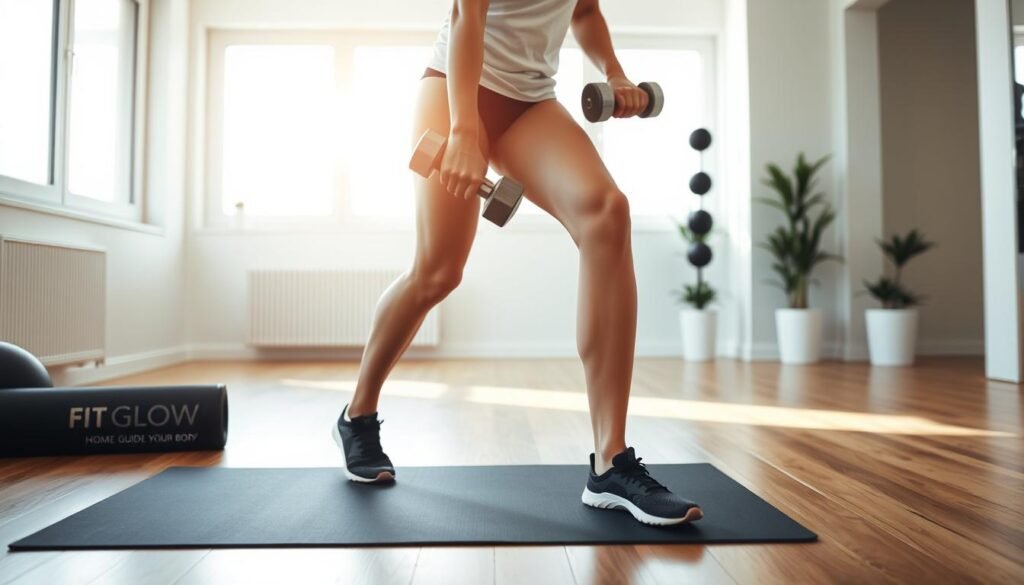
Did you know that you can achieve a comprehensive lower body workout without stepping into a gym? It’s time to rethink leg day. Traditionally, leg workouts are associated with heavy barbells and machines. However, dumbbells can be just as effective for building strength and toning muscles.
The Fit Glow Guide approach introduces an effective way to train your legs at home using dumbbells. This method is designed to help you achieve your fitness goals without the need for expensive gym equipment. By incorporating dumbbell exercises into your routine, you can target specific weaknesses and add variety to your leg workout.
Key Takeaways
- Effective leg training at home is possible with dumbbells.
- Dumbbell exercises can be as effective as gym-based routines.
- No need for specialized machines or gym membership.
- Home-based workouts fit into busy schedules.
- Improves muscle tone, strength, and overall fitness.
- A comprehensive lower body training program is achievable with minimal equipment.
The Benefits of Leg Day
Incorporating leg day into your workout routine can have a transformative effect on your overall fitness. Focusing on your leg muscles is essential for building a strong, balanced physique. The Fit Glow Guide emphasizes the importance of leg workouts in achieving overall body strength and aesthetic appeal.
Leg workouts engage some of the largest muscles in your body, including your glutes and quadriceps. By targeting these areas, you can significantly enhance your metabolic rate and burn more calories, both during and after your workout.
Building a Balanced Physique
A well-rounded fitness routine that includes leg day helps in achieving a balanced physique. Strong legs provide a foundation for overall body strength, improving your ability to perform daily activities and other exercises more effectively.
Reducing Back Pain and Injury Risk
Strengthening your leg muscles can also reduce the risk of back pain and injury. Stronger legs provide better support for your back, improving your posture and reducing the strain on your spine.
Burning More Calories
The bigger the muscle you work, the more energy your body needs to use it. Exercises that target your leg muscles, such as squats and lunges, are particularly effective at burning calories due to the large muscle groups involved.
| Benefits | Description |
|---|---|
| Caloric Expenditure | Leg workouts burn more calories compared to upper body exercises due to the larger muscle groups involved. |
| Metabolic Demand | The metabolic demand of leg training elevates heart rate and increases overall workout intensity. |
| Afterburn Effect | Leg exercises create an “afterburn effect” that continues to burn calories hours after your workout. |
Understanding Leg Muscle Groups
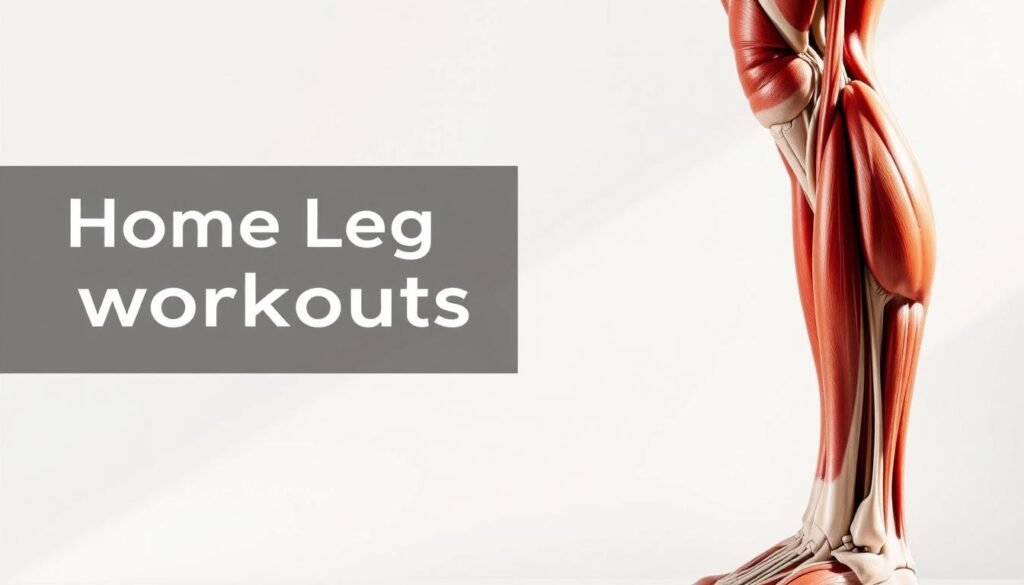
Understanding the anatomy of the leg muscles is essential for creating a balanced workout routine. The leg is composed of several major muscle groups that work together to facilitate movement and maintain balance.
Quadriceps
The quadriceps are a group of four muscles on the front of the thigh that are responsible for knee extension and straightening of the leg. Strengthening this area improves overall leg strength and stability.
Hamstrings
The hamstrings, located at the back of the thigh, are crucial for knee flexion and hip extension. They work in conjunction with the quadriceps to provide balanced movement and prevent injuries.
Glutes
The gluteal muscles play a significant role in hip extension and external rotation. Strong glutes are vital for maintaining proper posture, balance, and generating power during movements like running and jumping.
Calves and Stabilizers
The calf muscles (gastrocnemius and soleus) enable plantar flexion of the foot, crucial for walking, running, and jumping. Stabilizer muscles throughout the leg help maintain balance and proper alignment during movement. Unilateral or one leg exercises can help identify and correct muscle imbalances while strengthening these stabilizers.
Why Dumbbells Are Effective for Leg Workouts
Dumbbells offer a versatile and effective way to enhance leg workouts. They provide a range of benefits that can improve overall leg development.
Versatility and Convenience
Dumbbells are highly versatile, allowing for a variety of exercises that target different muscle groups in the legs. Their convenience is another significant advantage, as they are easy to use at home or in the gym.
Targeting Muscle Imbalances
Using dumbbells helps identify and correct muscle imbalances. Since dumbbells require more stabilization than machines, they engage both sides of the body equally, highlighting any weaknesses.
Improved Range of Motion
Dumbbell exercises allow for a greater and more natural range of motion compared to machine-based exercises. This leads to more complete muscle development and improved flexibility.
| Benefits | Dumbbell Exercises | Machine-Based Exercises |
|---|---|---|
| Range of Motion | Greater and more natural | Limited and fixed |
| Muscle Engagement | Engages stabilizer muscles | Limited to primary muscles |
| Versatility | Highly versatile | Limited to specific exercises |
By incorporating dumbbells into your leg workout routine, you can achieve a more balanced physique and enhance overall muscle development.
Essential Equipment for Dumbbell Leg Workouts
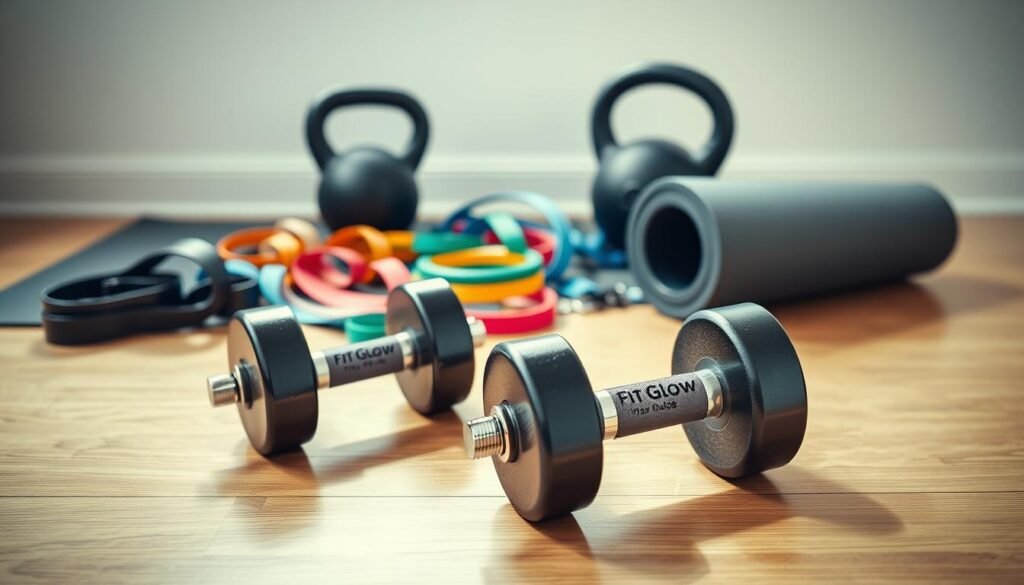
Effective leg workouts with dumbbells require minimal but essential equipment. The right gear can enhance your workout experience and improve results.
Choosing the Right Dumbbell Weight
Selecting the appropriate dumbbell weight is crucial for effective leg exercises. It’s about finding a weight that challenges you without compromising form.
Additional Helpful Accessories
While dumbbells are the primary equipment, additional accessories can enhance your leg workouts. A non-slip yoga mat provides cushioning for floor-based exercises and improves stability. A sturdy bench or chair is useful for elevated movements. Resistance bands can complement dumbbell training for warm-ups and activation exercises.
Warming Up Before Leg Workouts at Home with Dumbbells
Before diving into leg workouts at home with dumbbells, it’s crucial to prepare your muscles with a proper warm-up routine. This initial step is vital for enhancing performance and reducing the risk of injury.
Dynamic Stretching Routine
A dynamic stretching routine is an effective way to warm up. It involves movements like leg swings, lunges, and calf raises that increase blood flow and temperature in your muscles. Spend about 5 minutes on this to get your legs ready for the workout.
Activation Exercises
Activation exercises help “wake up” glutes and other underactive muscles. Focus on exercises like glute bridges, clamshells, and monster walks. These exercises ensure proper muscle recruitment during your main workout, reducing the risk of compensatory movement patterns that can lead to injury.
- Glute bridges target the glutes, helping to establish a proper mind-muscle connection.
- Clamshells activate the gluteus medius, crucial for hip stability.
- Monster walks engage multiple muscle groups, preparing them for compound leg movements.
10 Best Dumbbell Leg Exercises
To build strong legs at home, incorporating dumbbell exercises is highly effective. Dumbbells offer a versatile way to target various muscle groups in your legs, including your quadriceps, hamstrings, glutes, and calves. Here, we’ll explore the top 10 dumbbell leg exercises to help you achieve a balanced lower body.
Dumbbell Squats and Variations
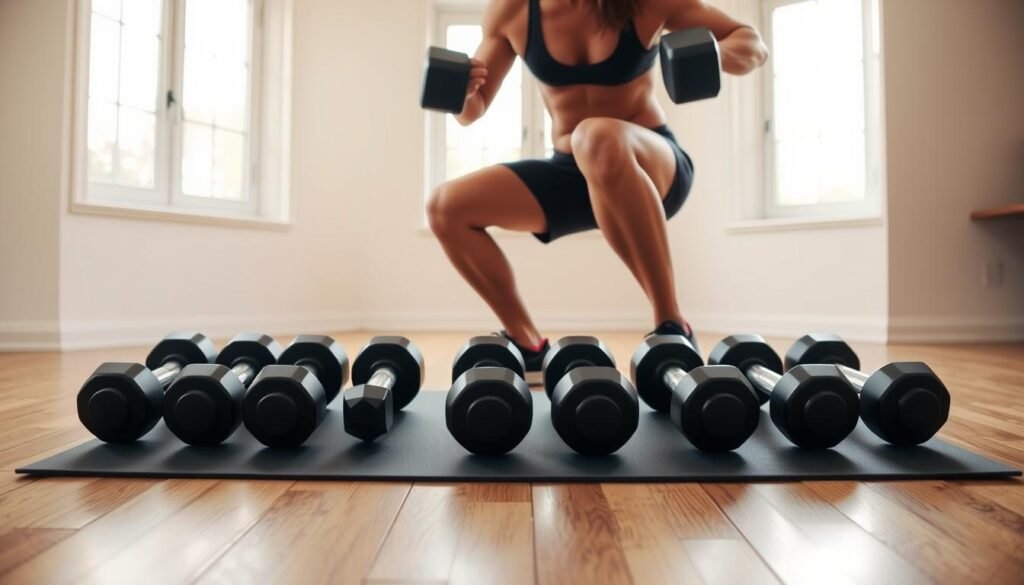
Dumbbell squats are a fundamental exercise for building leg strength. They target the quadriceps, hamstrings, and glutes. Variations of squats can help keep your workout routine interesting and challenging.
Goblet Squats
Goblet squats involve holding a dumbbell at your chest, which helps to improve your form and engage your core. This variation is excellent for beginners as it promotes proper squat technique.
Front Squats
Front squats with dumbbells target the quadriceps and glutes. By holding the dumbbells at your front, you shift the emphasis to the front of your leg, making it an effective exercise for building strength.
Dumbbell Lunges and Variations
Lunges are another effective exercise for targeting the leg muscles. They help improve balance and strength.
Forward Lunges
Forward lunges with dumbbells work the quadriceps, hamstrings, and glutes. They are a great exercise for improving balance and coordination.
Side Lunges
Side lunges target the adductor muscles in your thighs, as well as the glutes. This exercise helps to improve hip mobility and strength.
Dumbbell Deadlift Variations
Deadlifts are a compound exercise that targets multiple muscle groups, including the hamstrings, glutes, and lower back.
Romanian Deadlifts
Romanian deadlifts focus on the hamstrings and glutes. By bending at the hips and knees, you can effectively target these muscles.
Single-Leg Deadlifts
Single-leg deadlifts challenge your balance and target the hamstrings and glutes. They are an advanced exercise that requires control and strength.
Bulgarian Split Squats
Bulgarian split squats are a variation of lunges that target the quadriceps, hamstrings, and glutes. They require balance and can be challenging, making them effective for building strength.
Dumbbell Step-Ups
Dumbbell step-ups target the quadriceps, hamstrings, and glutes. They are an excellent exercise for improving leg strength and can be done with a bench or step.
Dumbbell Calf Raises
Dumbbell calf raises are an isolation exercise that targets the calf muscles. They can be done standing or seated, and are effective for building lower leg strength.
Dumbbell Glute Bridges
The dumbbell glute bridge is an effective exercise for targeting the glutes, particularly the gluteus maximus. By placing a dumbbell across your hips, you increase the resistance, making the exercise more challenging. To perform this exercise, lie on your back on the floor with your knees bent and feet flat. Engage your glutes to lift your hips, squeezing at the top of the movement.
Proper technique is crucial for maximizing the effectiveness of dumbbell glute bridges. Ensure that you are activating your glutes rather than relying on your hamstrings or lower back. This exercise is excellent for both beginners and advanced trainers, as it isolates and strengthens the gluteal muscles while minimizing stress on the lower back.
Complete Dumbbell Leg Workout Routines
Maximizing your leg workout with dumbbells requires a strategic approach to exercises and routines. To help you achieve your fitness goals, we’ve outlined three comprehensive workout routines tailored to different fitness levels.
Beginner Routine
For those new to leg workouts, start with 3 sets of 8-12 reps for exercises like Dumbbell Squats and Dumbbell Lunges. Rest for 60-90 seconds between sets. This routine should be done 2 times a week, allowing for 72+ hours of rest between sessions.
Intermediate Routine
As you progress, increase the intensity with 4 sets of 10-15 reps. Incorporate exercises like Dumbbell Deadlifts and Bulgarian Split Squats. Rest for 60-90 seconds between sets, and perform this workout 2-3 times a week.
Advanced Routine
For advanced trainers, a high-volume, high-intensity routine is recommended. The workout includes:
| Exercise | Sets | Reps |
|---|---|---|
| Dumbbell Front Squats | 4 | 6-8 |
| Single-Leg Deadlifts | 4 | 8-10 per leg |
| Bulgarian Split Squats | 4 | 8-10 per leg |
| Goblet Squats | 3 | 12-15 |
Rest for 45-60 seconds between supersets, and perform this workout 2 times per week with 72+ hours between sessions, managing your time effectively to allow for recovery.
Proper Form and Technique Tips
To get the most out of your leg workouts at home, it’s essential to focus on proper form and technique. This not only enhances performance but also reduces the risk of injury.
Maintaining Correct Posture
Maintaining the correct position is vital during leg exercises. Ensure your back is straight and your core is engaged to support your movements. This helps in stabilizing your body and targeting the correct muscle groups effectively.
Breathing Techniques
Proper breathing techniques play a significant role in strength training. Inhale during the eccentric phase (lowering the weight) and exhale during the concentric phase (lifting the weight). This helps in stabilizing your core and optimizing your movement. For heavy lifts, some advanced lifters use the Valsalva maneuver to enhance stability.
By coordinating your breathing with your movement, you can maintain core stability, increase power output, and manage intra-abdominal pressure, thereby protecting your spine during heavy lifts involving significant weight.
Common Mistakes to Avoid
To maximize the benefits of dumbbell leg workouts, it’s essential to be aware of and avoid several common pitfalls. Proper form and technique are crucial for effective and safe exercise.
Improper Knee Alignment
One of the most common mistakes during leg exercises is improper knee alignment. Ensuring that your knees are in line with your toes can help prevent unnecessary stress on your joints. Proper knee alignment is vital for maintaining the correct position and avoiding potential injuries.
Insufficient Range of Motion
Not moving through a full range of motion can reduce the effectiveness of the exercise and lead to muscle imbalances. It’s essential to control the movement and ensure that you’re working your muscles through the entire range.
Using Momentum Instead of Control
Using momentum rather than controlled muscle action can reduce the effectiveness of exercises and increase injury risk. Signs include swinging weight rather than lifting it, and rushing through repetitions without maintaining proper form, thus reducing time under tension.
| Common Mistake | Proper Technique | Benefit |
|---|---|---|
| Improper Knee Alignment | Knees in line with toes | Reduced joint stress |
| Insufficient Range of Motion | Full range of motion | Effective muscle engagement |
| Using Momentum | Controlled movement | Increased time under tension |
Progressive Overload for Continued Results
Progressive overload is key to making consistent gains in strength and muscle mass in your legs. It’s a training principle that involves gradually increasing the intensity of your workouts to challenge your muscles and stimulate growth.
One effective way to achieve progressive overload is by adjusting the variables of your workout routine. This can be done in several ways, including increasing the weight used, manipulating reps and sets, and altering the time under tension.
Increasing Weight Gradually
Increasing the weight used in your dumbbell leg workouts is a direct way to challenge your muscles. Gradually add weight as you get stronger to continue making gains in strength. Aim to increase the weight by small increments to avoid plateaus.
Adjusting Reps and Sets
Another strategy is to adjust your reps and sets. By adding more sets or increasing the number of reps, you can increase the overall volume of your workout, challenging your muscles further. For example, you can move from 3 sets of 8 reps to 4 sets of 10 reps.
Additionally, you can change the tempo of your exercises, slowing down the eccentric phase to increase time under tension. This not only stimulates muscle growth but also enhances strength. Ensuring adequate recovery is crucial when increasing the intensity or volume of your workouts.
- Manipulating reps, sets, and rest periods to create progressive overload.
- Increasing volume and intensity through adjusted rep and set schemes.
- Changing tempo to increase time under tension and stimulate growth.
Recovery and Rest for Leg Muscles
The importance of recovery and rest cannot be overstated when it comes to leg workouts. Adequate rest is essential for muscle repair and growth.
Post-Workout Stretching
After a leg workout, post-workout stretching can help reduce muscle soreness and improve flexibility. Focus on stretches that target your major leg muscle groups.
Rest Day Recommendations
Allow 48-72 hours between intense leg sessions for proper recovery. On rest days, consider active recovery activities like walking or light cycling to enhance blood flow to your legs and support overall strength development.
Conclusion: Building Strong Legs at Home
With the right approach and equipment, such as dumbbells, you can effectively build strong legs from the comfort of your own home. The Fit Glow Guide approach makes it possible to achieve your leg development goals without expensive gym equipment or memberships. By incorporating leg workouts at home with dumbbells into your routine, you can enjoy the benefits of convenience, effectiveness, and versatility.
To achieve impressive results, focus on consistency, proper form, and progressive overload. Start with the beginner routine and gradually progress as your strength and confidence increase. With patience and dedication, you can develop strong, shapely legs that enhance your overall body fitness.
FAQ
What are the most effective dumbbell exercises for targeting the quadriceps?
Dumbbell squats and variations, such as sumo squats, are excellent for targeting the quadriceps. Additionally, dumbbell step-ups and Bulgarian split squats also effectively engage the quads.
How can I avoid knee pain during dumbbell leg exercises?
To minimize knee pain, ensure proper knee alignment during exercises like squats and lunges. Keep your knees in line with your toes, and avoid extending them past your toes. Strengthening your surrounding muscles, such as the glutes and hamstrings, can also help.
Can I use dumbbells to target my glutes effectively?
Yes, dumbbells can be used to effectively target the glutes. Exercises like dumbbell deadlifts, glute bridges, and Bulgarian split squats are great for engaging the gluteal muscles. Proper form and sufficient weight are crucial for maximizing glute activation.
How often should I perform leg workouts with dumbbells?
The frequency of leg workouts depends on your fitness goals and current level. Generally, 2-3 times per week is a good starting point, allowing for adequate rest and recovery time between sessions.
What is progressive overload, and how can I apply it to my dumbbell leg workouts?
Progressive overload involves gradually increasing the weight or resistance to challenge the muscles and promote continued growth. To apply it, incrementally increase the dumbbell weight, or adjust the number of reps and sets over time as your strength improves.
Are dumbbell leg exercises suitable for beginners?
Yes, dumbbell leg exercises can be modified to suit beginners. Start with lighter weights and focus on proper form and technique. As you become more comfortable, you can gradually increase the weight and intensity.
How can I ensure I’m using the correct form during dumbbell leg exercises?
To ensure correct form, focus on maintaining proper posture, engaging your core, and controlling the movement. It’s also helpful to watch instructional videos or consult with a fitness professional to learn proper technique.